Featured Guitar – Vintage Regal Tenor Resophonic
Sometimes the guitar itself is more interesting than the repair. It would be a shame not to share some of those instruments. So with that in mind, presenting our first “Featured Guitar.”
This Martin guitar took a serious fall, snapping the headstock off completely. See how we made it look like it never happened while keeping every bit of strength it had before.

This is never how you want your Martin to look. But if your headstock does break off, you’d like to at least see a long break like this one with plenty of lateral gluing surface. Modern wood glues work their way into the pores of the wood, fusing them together again with incredible strength. Some repair shops take the approach of cutting away some of the wood and inlaying a dowel or a new piece to splice the two sides together. There are times when this is called for, but we try to avoid such measures whenever possible because it breaks and cuts even more of the wood fibers. If it ain’t broke don’t break it! Continue »
Two more vintage Mossman acoustics get the superhero treatment – a neck reset, refret, custom pick guard, and a new brace.

Not long after posting photos of our previous Mossman neck reset, we received two more Mossman guitars that needed the same treatment, but with an extra necessary step. Since they received identical work, the photos in this post will jump between the two guitars. You’ll see them receive neck-resets, re-frets and that extra step – the addition of a brace that was missing in the original design. The guitar in that previous post was made a few years after these and by that time the design flaw had been remedied. After years of not seeing this company’s guitars, it was interesting to see a number of them arrive so close to each other. Continue »
A family heirloom gets a new life for the next generation of strummers.

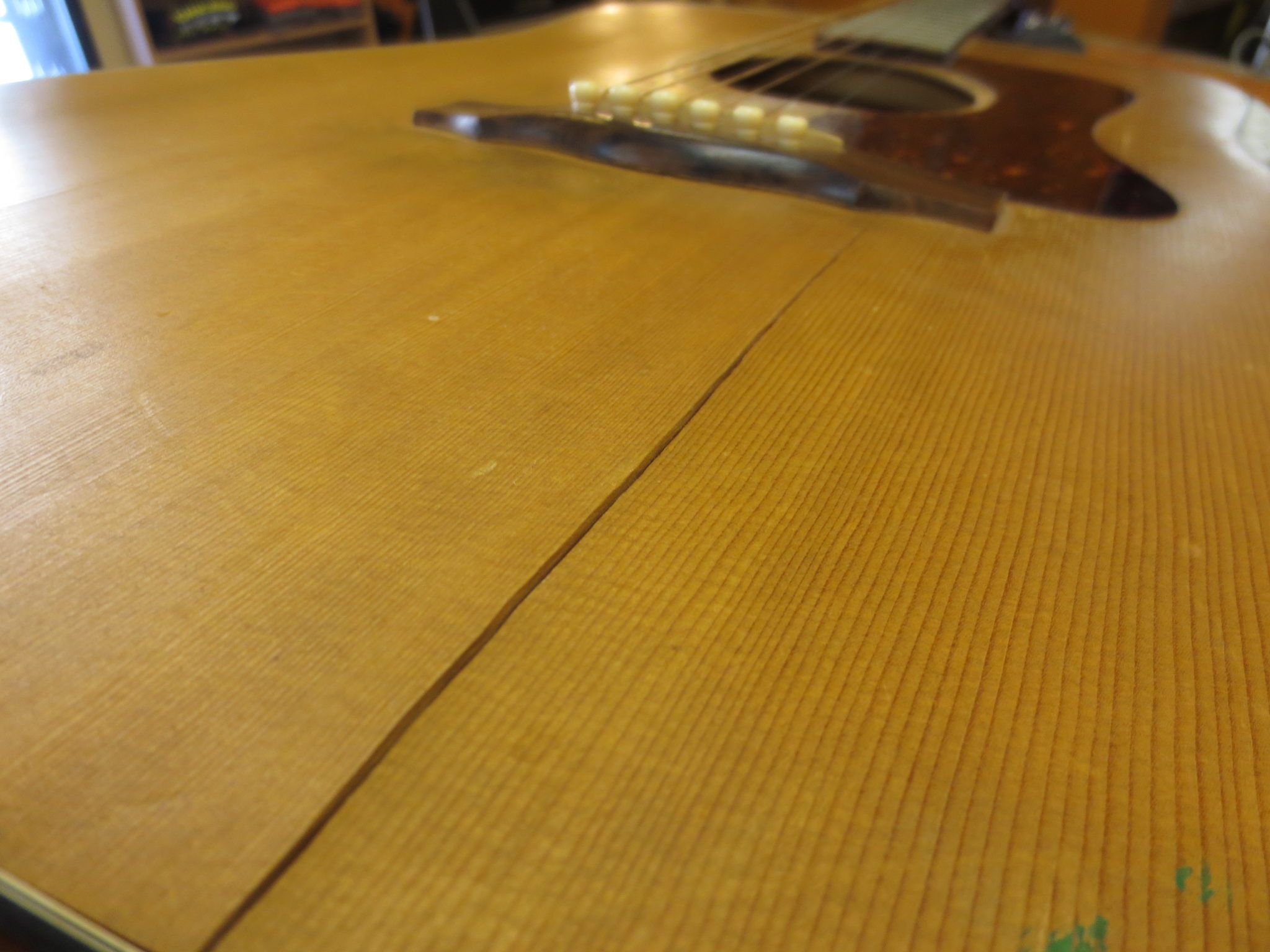
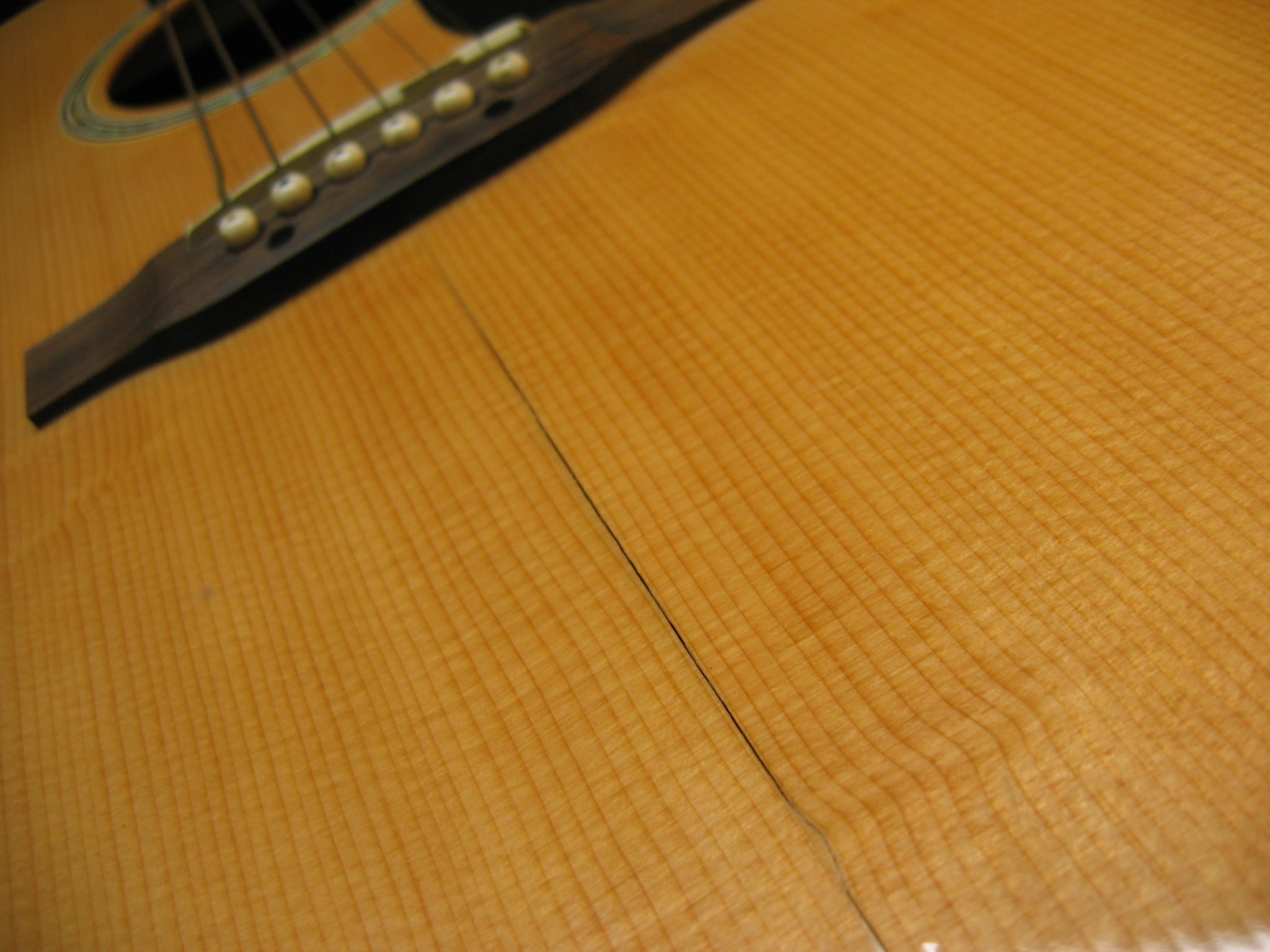
We weren’t sure we believed a phone caller who said his vintage Gibson acoustic guitar had a crack in the top that was open more than a quarter inch. But when he brought it in, sure enough that crack above the sound hole had buckled and bent until it was open wide. This crack likely started out as a hairline split on a guitar that hadn’t been sufficiently humidified. It wasn’t repaired right away and over time the top wood curled up and almost completely separated from the brace underneath. It’s a tricky repair that came together quite nicely. While we were at it, we reset the neck, planed the fretboard level, replaced the frets, and replaced the dried and curling pickguard with a custom-cut new guard that fit right in with this old beauty.
Here’s an early 1980’s Greco Super Real Goldtop as it arrived in our shop. Take a look at how we gave it a more authentic and vintage appearance.

The Greco Super Real is one of the more sought-after copies of the Gibson Les Paul. They consistently fetch upwards of $1500 on eBay and in our opinion, outshine many of the more common varieties. It’s got great weight, feel, and sound but the appearance is a little less convincing. The owner of this guitar noticed that it had an orange-hued finish that was clearly not the traditional nitrocellulose lacquer found on Gibson guitars. He asked us to refinish it in nitrocellulose and relic the appearance so that it looks more like a genuine vintage Les Paul.
Those original goldtops got their look from clear lacquer finish applied over bronze powder. Over time, the clear finish would wear thin and ‘check,’ exposing the bronze to arm sweat and the oxygen in the air. As a result, many of these 50+ year old guitars have taken on a greenish appearance in the more heavily worn areas. The Greco’s owner knew this and specifically wanted to see this subtle effect on his guitar – which means simulating fifty years of wear and tear in a brand new finish. You’ll see we were up to the challenge. Continue »
“An ounce of prevention beats a pound of cure.” In this post, we’ll break down the best way to protect your guitar in the cool months ahead.

Chicago winters kill guitars. The weather gets dry and cold, so we turn on our furnaces – drying out the air in our homes even further. Many will see their indoor relative humidity drop below 20% . That’s 25-30% lower than the factories where guitars are made and the wood just doesn’t like it. Like the skin on our fingertips and the seams on our hardwood floors, dry guitars can split open without ever being dropped or otherwise mishandled. Other symptoms we see include:
So what can you do to prevent costly repairs to these problems? There’s so many choices hanging in guitar stores that it can be hard to tell which one to buy. We may kick ourselves for giving away the secrets that keep us in business – but here’s a look at the products that will best help you keep your guitar healthy and happy this winter. You’ll also find a simple formula for how to effectively use them.
Lenny Davidson of the Dave Clark Five pays us a visit.

A favorite customer and friend of ours came in with his father to get a little work done on dad’s travel guitar. Some of the tuning gears had been stripped to Bits and Pieces so we installed a new set and strung it up. Dad, as it turns out, is Leonard “Lenny” Davidson of The Dave Clark Five. He was kind enough to tell some great stories of playing alongside a 14 year old Jimmy Page, of playing The Ed Sullivan Show and Carnegie Hall, and of a ‘61 Strat he kind of wishes he hadn’t sold for 70 pounds. The DC5 were inducted into the Rock N Roll Hall of Fame in 2008 and here’s some excellent video of that night. Thanks for the visit and for snapping a picture with us.
When it rains it pours, and my partner Dan has been up to his elbows in binding repairs this year. Here, he replaces the dried and crumbling binding from a vintage Gretsch Country Gentleman.

A common problem on vintage Gretsch guitars is the decay and crumbling of the outer celluloid binding strip. Sometimes, owners will opt to leave the cracked binding alone, but in this particular guitar’s case, the owner wanted it repaired. In areas, it was loose enough to be scraped off with a fingernail and in others it needed to be scraped and even chiseled off. We ended up replacing the outer layer entirely, then touching up the nitrocellulose finish.
Hold on there! Refinish a vintage Gibson? In candy apple red?? There better be a darn good reason to do something like that… and there was.

As mentioned in previous posts, the guitar repairman’s rule of thumb with vintage instruments is to leave it in as close to original condition as possible while still maintaining its playability. In the case of this 1960’s Gibson ES-355TDC, a couple of previous repairs have left it far from its original condition. When it arrived, the most obvious change was that it had been painted white years earlier and that white finish was flaking off in big chunks. A little closer look revealed a headstock repair the likes of which we’ve never seen. Throw in some long ago water damage, cracks in the body, and stains in the wood and the vintage value of the guitar is pretty well gone. You may as well paint it blue; or as the owner of this guitar decided, candy apple red. Continue »
In this post, you’ll see how we tackle a very difficult neck re-repair on a Chicago-made Lyon and Healy Style-A Mandolin.

A new customer brought us a remarkable and beautiful Lyon & Healy mandolin that was made here in Chicago nearly a century ago. This is a “Professional” or “A” Style instrument that was at the top of the company’s line of mandolins in the 1920’s. It has a very delicate and ornate scroll headstock that unfortunately broke apart many years ago. It was fixed and the repair held for a long time before recently coming apart. Our challenge is to get the headstock solid enough to play again, while maintaining as much of the instrument’s original qualitity and character as possible. What’s more, we’ll need to work around a few unexpected elements of the previous repair. Continue »